Monday, April 21, 2008

The Good Luck Cat


 Harjo, Joy. The Good Luck Cat. San Diego: Harcourt, 2000.

The Good Luck Cat is a great book for young elementary students.  The book tells a normal story about a young Native American girl who has a lucky cat.  She tells how the cat has gone through her nine lives.  The story of the cat’s ninth life is the cat disappearing.  In the end the cat, Woogie does find her way back to the girl’s house.  There are only a couple references to Native American culture. On the second page of the book the girl tells the reader that her aunt gave her money to buy new shoes she would like to wear to the spring powwow. Some other information is given when the girl tells about Woogie’s eighth life.  The girl wanted to take Woogie with her and her family to the powwow they were attending.  So the girl hid her cat in a box with her family’s outfits for the powwow.  From the picture that goes along with this page you can see that the outfits the girl mentions look like traditional powwow clothing. 

Joy Harjo is an insider author from the Muscogee tribe. Harjo has received The American Indian Distinguished Achievement Award, two NEA Creative Writing fellowships, the Delmore Schwartz Award, the William Carlos Williams Award from the Poetry Society of America, and the Witter Bynner Grant for Poetry.

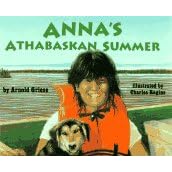
Anna’s Athabaskan Summer


Griese, Arnold. Anna's Athabaskan Summer. Honesdale: Boyds Mill Press, 1995.

Anna’s Athabaskan Summer is a story aimed for elementary age children.  Anna’s family, who lives in Alask and is of Athabaskan decent, goes to a special place each summer where her ancestors lived.  Anna’s family fishes for salmon on the river where her family goes each summer.  Her grandmother tells her stories about the beliefs Athabaskan’s have dealing with nature and creation.  Her mother also informs her about the respect their people have for all living things.  She tells Anna they must only take the fish they need, and return what is not needed back into the river.  As the weather grows colder once again, Anna wishes summer did not have to end.  Anna’s grandmother reminds her that summer will always come again, and that she will always be a part of Anna’s life even after she is gone.  Anna and her family leave their summer home and the place where the Athabaskan Indians once lived all together, remembering that they will come back next summer and she will bring a friend who she can teach about her ancestors as well.

            Arnold Griese is not an insider author, but he has done extensive research about the Athabaskan Indians.  He has been immersed in the culture when he moved to Tanana, an Athabaskan village in Alaska.  He taught within a schoolhouse in the village.  Grises focuses on one Indian tribe, which is good since he is not stereotyping or generalizing about Indians in general.  Griese also shows that Native Americans live regular lives and dress and talk like everyone else through his contemporary setting and Ragins illustrations.  Grieses story qualifies as good multicultural literature when thinking about the question of, does the story question themes of a minority and then try to answer them.  Anna questions the traditions and beliefs of the Athabaskan Inidians and receives answers from her mother and grandmother.

The Arrow Over the Door


Bruchac, Joseph. The Arrow Over the Door. New York: Dial Books for Young Readers, 1998.

Bruchac’s novel, The Arrow Over the Door, for upper elementary and middle school students is historical fiction about a Quaker boy and an Indian boy during the Revolutionary War.  The story takes place in 1777 and alternates between viewpoints of Samuel, the Quaker boy, and Stands Straight, the Indian boy.  The Indian boy is part of the Abenaki tribe and he is scouting for King George.  Samuel, growing older and more mature questions his family’s beliefs about being friends with everyone throughout the story.  For example, his house does not have a lock on the door because his father believes a lock on the door shows that the owner is worried about items being stolen from inside and is not welcoming to others.  Samuel continues to question his family’s beliefs throughout the novel.  Samuel’s family goes to a meeting with other Friends or Quakers to discuss the war and their feelings and thoughts about it.  At the same time, Stands Straight is in the woods near the Quakers meeting place with his uncle and other Abenakis who are assessing the Quakers and thinking about taking some of them as captives in return for their family members that have been killed.  The Abenakis approach the Quaker’s meeting and decide not to use any violent actions against them since the Quakers do not have any weapons.  They place an arrow over the door as a sign of friendship.

            Bruchac is an insider author. He has origins in the Abenaki Indian tribe.  He has written many other pieces of children’s literature and is a noted Native American author.  He has used his background to displace stereotypes and create a quality piece of multicultural literature in The Arrow Over the Door.   Bruchac informs the reader through his author’s note at the end of the book about the research he had done in order to write this story. He made sure to leave out stereotypes of the Indians having cruel faces or being described as savage and warlike.  Although Bruchac does leave these stereotypes out he still includes some feelings of dislike about the Indians from the viewpoint of characters like Tom Watt. Tom says he is afraid to be scalped by the Indians.  Lines like these would need to be discussed in class showing that this could be a valid fear from certain viewpoints but is also a stereotype of Indians.  Making sure the students see both sides of history, like most of the book presents with alternating chapters from Samuel and Stands Straight, would be very important while using or suggesting this book.

Sunday, March 30, 2008

Online Computer Game Helps People with Autism

As I was looking at my daily source of news, CNN.com, the other day I came across an article titled, "iReport: 'Naughty Auties' Battle Autism with Virtual Interaction."  After reading the article I made a connection to our diverse literature class since we have already gone over the topic of autism.  In the iReport written by Nicole Saidi, it discusses how the virtual online world called Second Life can provide a place for people with Autism to practice their social interactions.  The article interviews David Savill a 22 year old from England who has Asperger's syndrome.  David shares how he has created a name for his character in the virtual world he created in Second Life along with some of his experiences with the site. Saidi states, "The graphical representations of real people create a "comfort zone" that can coax users out of their shells and get them communicating with others, he said."  Savill also states that the fact people are at their personal computer in their own room and own house provided a comfort level that in part allows for the social interactions being made within the virtual world to be ok.  The article also discusses how the vritual world can also be joined by family members of people with autism.  This way it can also be a learning experience for them as well.  Saidi makes sure to point out though that there has not been scientific research done to prove that a virtual world like Naughty Auties helps treat autism.  Researcher Simon Bignell plans on looking at the effect the virtual world can have on people with Autism.  
You can find the article at: http://www.cnn.com/2008/HEALTH/conditions/03/28/sl.autism.irpt/?iref=mpstoryvie.  I also found another related article titled, "Virtual World Teaches Real World Skills" which can be found at: http://www.msnbc.msn.com/id/7012645/.

Monday, March 17, 2008

Personal Philosophy

Since they beginning of my classes at MSU in the College of Education, I feel like the issue of diversity has been an integral part of discussion and course work.  The topic has interested me each time it has been a part of courses like 301, 348, and 401.  When I heard about TE 448 focusing on diversity in children and adolescent literature I thought it would be a great class to further my knowledge about diversity and it would provide me with new knowledge about literature that is appropriate and good to use in my classroom in the future.

In relation to why I am taking the class, this class directly relates to some of my professional goals.  I would like my classroom to be a safe and comfortable place for all students, no matter what background, culture, ethnicity, or religion they identify with.  In order for this safe and comfortable environment to occur each student should be able to see themselves within literature in the classroom.  Also they should not see negative stereotypes of themselves in literature within the class.  The latter part of my goal may be impossible though, since as we have seen in class with the books we have read, stereotypes can be found in almost anything we read... so it will also be a goal of mine to always critically discuss and read books and focus on making sure stereotypes are not enforced to the students.

With my personal goal of students feeling safe and comfortable within the classroom also comes the role of diversity within all aspects of class, especially literacy teaching and learning.  Since literacy is a main aspect of all other subjects like math, science, and social studies it is extremely important to have diverse literature and diverse thoughts throughout all academic subjects. Specific issues within diversity like being an insider or outsider and stereotyping will be important to consider when teaching diverse literacy.  In order for the literature to be credible the author needs to have a significant amount of experience and research into the minority culture being written about.  I also think that issues of diversity that come up in class with teaching and learning about diverse literature can be great on the spot teaching moments.  If students disagree or share their different points of view about an idea or event because of their culture, this can be a great opportunity to discuss diversity and how people can have different opinions.  These different opinions need to be respected and attempted to be understood. This can teach students and ourselves valuable lessons about how to interact with others who have differing opinions on issues throughout life.

My personal philosophy about multicultural education includes my professional goals relating to diverse literature.  I think that multicultural education is extremely important so all students feel like they are in a safe environment mentally, physically and emotionally.  If students all respect each other then this type of environment can be achieved. Diverse literature needs to be present within the classroom.  Not only does it need to be present, but it also needs to be read, thought about and discussed critically.  I would like students within my classroom to share with each other how they create a diverse classroom.  Each student is different therefore they each bring something to the classroom's diversity.  If students have literature at home about their culture or religion or ethnicity or anything that might make them different from others I would encourage them to bring this into the class to share and for others to read.

It is very exciting to think that I will soon be able to apply my philosophy about diverse literature and multicultural education to the classroom.  I am interested to see what type of classroom I will be teaching, how obvious diversity will be within the class.  I know that there is diversity in each situation and each class, but some students may not see diversity if all the students are middle class and white, opposed to a class of students with many different races or cultures.  It also interests me to see how much children either accept the ideas of diversity I will present or how much they do not have interest in it.  I hope that all my students see how important it is too look at diversity, especially within literature.  It is a concern though that the students will not be interested or will not understand the ideas of diversity I would like to teach.  I am also concerned that I will use literature or something will happen in my class that offends a student because of their culture.  I know that if something like this happens I should revisit the situation and use it as a learning experience in order to tell the students how something was offensive or inappropriate and what we can do as a class so the situation does not reoccur.  Even with my worries I am still looking forward to incorporating diverse literature into my class so my students have a wonderful opportunity to be well rounded successful adults while enjoying reading and writing about different cultures and ideas.


Thursday, February 28, 2008

Al Capone Does My Shirts and Autism movie

Personally I do not have a depth of knowledge about disabilities or special education.  While reading Al Capone Does my Shirts, discussing disabilities in class, and watching the movie on Autism my interest has been piqued.  I found it interesting the difference between the autism presented in Al Capone does my shirts with Natalie compared to the woman in the video with autism.  In the video a doctor who studies autism said it is believed that autism has to do with how the brain is wired.  Some connections seem to be wired correctly and others are not.  This definition gives me a little bit of a clearer picture of how autism occurs and what the difference is between a person with autism compared to a person without.
I also found it interesting in both Al Capone Does my Shirts and the movie how the mother of the child with autism reacted to the situation.  Within the novel the mother is very protective of Natalie and really wants her to go to the Ester P. Marinoff School so she can get better.  The mother puts a lot of responsibility of taking care of Natalie onto Moose, the 12 year old boy.  She always puts Natalie first, which is partly understandable because of her disability but I think she was giving too much pity versus empathy to Natalie.
In the video the mom used surprising language to describe her daughter.  She used retarded and handicap to describe her daughter. This seemed unusual to me because of the connotation these words have.   Like Linton discussed in his article these are perceived and taken by the disabled community as "nasty" words.  Maybe the language the mom used had to do with the time period that the movie was created in, I am not sure when it was created.
Along with the mother, the woman with autism also used interesting language to describe her condition.  She continued to refer to her behaviors as awful autism behaviors.  I understand that the woman may wish she did not have these tendencies, but it also seems like she has had them her whole life and should grow to live and accept them.  She is functioning so much better than previously, you would think she would at least be thankful for this part of her life.  I am not saying that she was not grateful but I thought it was odd for her to call her autistic behaviors awful as opposed to just saying she was working towards eliminating them.
After reading Al Capone Does my Shirts, having a discussion in class, and watching the video on autism I am interested in learning more about disabilities in general and about autism. It is very valuable for me to be knowledgeable in this area so I am prepared for any type of student and so I can learn about others who are different from me and learn and grow from these differences.

Tuesday, February 19, 2008

Bronx Masquerade and African American Stereotypes

I enjoyed my group's book talk for Bronx Masquerade.  I was able to share my question with my group and hear their opinions on the question I raised.  This question was,  "why does Tyrone express feelings of understanding and acceptance of others differences, but still seems to stereotype his peers?" My group members agreed that Tyrone seemed to stereotype others and we were not sure if this was the purpose of the author or not. I thought Kat's insight into the book was nice to hear as well.  Even though I had considered the stereotypes in the book, I hadn't considered every role the characters had (like the teen mother, basketball player, rapper...) as being stereotypical like she pointed out. I also thought the discussion we had about language was interesting.  I had not thought about that before class either.  I see both sides of the discussion. On one hand I would think the language the students used would have been much more vulgar and profane.  But the book is often used in schools and may not have been published with different language.  I still really enjoyed Bronx Masquerade, but like each of the other books we have discussed it has its flaws.  This book can still be used to discuss diversity as long as discussion intervenes with the reading of the book in a classroom.